
Enhancing weight loss outcomes with support
The impact of CVS Weight Management®

Introduction
Clinical guidelines for weight loss universally recommend individualized lifestyle interventions* to promote effective and sustainable weight management. Healthy lifestyle transitions* such as improvement in diet, physical activity and other behaviors can be challenging for individuals to implement but are often necessary for long-term weight stability and success.
Structured lifestyle programs that provide behavioral counseling interventions to support improved nutrition and exercise have demonstrated effectiveness in reducing weight* and mitigating obesity-related comorbidities*.
Glucagon-like peptide-1 receptor agonists (herein GLP-1s) have emerged as agents for weight loss and obesity treatment. Despite increased weight loss outcomes attributable to these agents, many patients continue to experience suboptimal or transient results when pharmacotherapy is used as the only intervention. In clinical trials evaluating GLP-1s for the treatment of obesity, approximately 9 to 15 percent of participants* were not able to achieve body weight reductions of 5 percent or greater from baseline, even while following the same treatment protocols.
Data from industry GLP-1 clinical trials show that ~9 to 15% of participants* were not able to achieve weight reductions of 5% or greater

Evidence continues to support that improved nutrition and regular physical activity are needed to promote healthy outcomes. GLP-1s are part of a clinical toolkit that can help enhance weight loss results.* In contemporary weight management, combining evidence-based behavioral support with pharmacologic intervention can produce the most favorable trajectory for both weight reduction and maintenance, helping individuals improve health outcomes through various lifestyle changes.
The CVS Weight Management® program is available to more than 3 million CVS Healthspire® plan members to date.
It offers rigorous lifestyle support for those who are already using — or those who may start using — weight management medications such as GLP-1s. This valuable program empowers members through a holistic approach that includes:
- One-on-one medical nutrition therapy from a dedicated registered dietitian (RD) in a virtual setting with personalized nutrition planning that considers individual needs, preferences and goals
- Clinical oversight from board-certified providers to help ensure that members have assistance with medication concerns and optimization
- Robust digital experiences including an engaging app, a connected scale and other devices as needed to empower members in their daily lives
This evaluation of the CVS Weight Management program focuses on an adherent group of individuals who had started GLP-1 therapy prior to enrolling in the program.
Drawing on real-world data, this analysis shows that programs offering structured lifestyle intervention, behavioral coaching and activity-based education can improve weight management outcomes. These results highlight the importance of merging pharmacological innovation with real-world programs that consider the multifaceted nature of obesity care and weight-related health.
Methods
Data derived from multiple clients that implemented the CVS Weight Management program were retrospectively analyzed.
Included adult program participants had the following:
- Body mass index (BMI) values classified as obese (≥30 kg/m2) or were considered overweight (≥27 kg/m2) with at least one weight-related comorbidity
- Previously filled a GLP-1 prescription for a weight loss indication at least 6 to 12 months prior to joining the program
- Medication possession ratio (MPR) of greater than 80 per cent calculated as total number of days’ supply of GLP-1 divided by total number of days
Individuals were classified based on weight reduction prior to program enrollment as responders or nonresponders. Nonresponders to GLP-1 therapy achieved less than 5 percent reduction in body weight prior to program enrollment.
Weight change, defined as the percentage change in an individual’s average monthly body weight value relative to their weight when starting GLP-1 therapy, was assessed at program start, and and 3, 6 and 9 months post-program enrollment. Retention rate at each period was calculated as the proportion of individuals remaining in the study relative to their initial classification as responders or nonresponders to GLP-1 therapy. Differences in weight loss were assessed using independent t-tests with Bonferroni correction applied to control for multiple comparisons. Bonferroni adjusted estimates were considered statistically significant at P < 0.01. This analysis involved secondary analysis of previously collected, de-identified data and met criteria for Institutional Review Board exemption.
Participants continued to lose weight after enrolling in the CVS Weight Management program

Results
CVS Weight Management enhances weight loss for previous GLP-1 responders and nonresponders
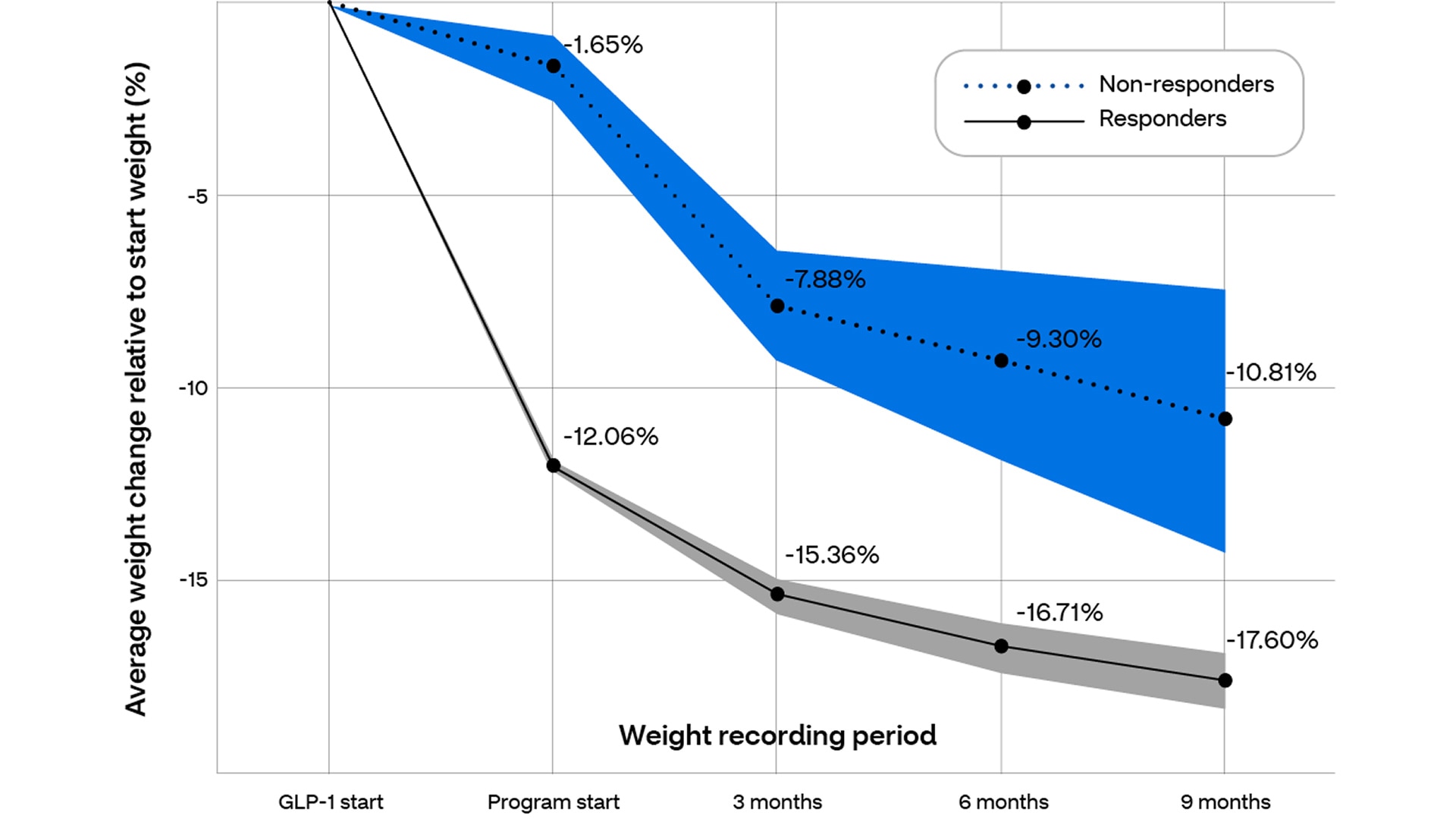
Approximately 98.8 percent of GLP-1 users continued to lose weight after enrolling in the CVS Weight Management program. After 9 months, program participants lost an average of 17.1 percent of body weight relative to their weight at the start of GLP-1 therapy. Within both responders and nonresponders to GLP-1 therapy, the differences in weight change between pre-program and program start (GLP-1 start to program start and program start to 3 months, respectively) were significant (P < 0.01).
Initial nonresponders to GLP-1 therapy experienced increased average relative weight loss after starting the weight management program, 6.23 percent at 3 months post-enrollment. These findings demonstrate two key outcomes. First, the CVS Weight Management program helps previously consistent GLP-1 users who are not responding achieve clinically and statistically significant weight loss within 3 months. Second, the program continues to maximize weight loss in the responder cohort as well.
After 9 months, program participants lost an average of 17.1% in body weight

All comparisons between the nonresponders and responder groups were significant (P < 0.01), indicating persistent differences in weight loss based on initial GLP-1 therapy results. Increase in weight loss variability was observed over time, as evidenced by widening 95 percent confidence intervals (CI). This trend was particularly considerable in the nonresponders to GLP-1 therapy who initially experienced weight loss challenges before program enrollment, suggesting that while most participants in this cohort lost weight, more variable outcomes were observed.
Despite continued weight loss on average in both responders and nonresponders, no statistically significant difference in weight loss was observed between the final weight recording periods (6 months to 9 months). These findings are consistent with existing evidence that suggest a natural inflection point of weight loss plateau* and transition to maintenance. CVS Weight Management utilizes an individualized and member-driven approach to manage transitions in the care journey from early weight loss to maintenance phases.
Figure 1: Shows the average percentage weight change relative to weight at the start of GLP-1 therapy for nonresponders and responders over five different weight recording periods. Shaded regions reflect bounds for 95 percent confidence intervals.
Key takeaways
Program participants continued to lose weight after enrolling in the CVS Weight Management program. Individuals who did not lose significant weight on GLP-1 medications before enrolling in CVS Weight Management experienced substantial weight reduction after program initiation, suggesting that program-offered support can help overcome drug therapy challenges.
Trajectories in weight maintenance
Weight loss trajectories demonstrate that most existing GLP-1 users achieve increasing progress in weight loss outcomes over time supported by the robust resources of the CVS Weight Management program. Within program start to 3 months after enrollment, nonresponders experience increased weight loss success, even almost outperforming the responder group with higher distributions in weight loss relative to GLP-1 start weight. However, beyond the initial 3 to 6 month window, GLP-1 users typically experienced either continued weight loss, gradual plateau or partial regain as visualized in Figure 2. These patterns are more notably observed in the nonresponder group.
Figure 2: Shows the distribution of average weight change relative to weight at the start of GLP-1 therapy for nonresponders and responders over five different weight recording periods

Key takeaways
Nonresponders, who did not initially experience significant weight loss on GLP-1s, begin to achieve increased weight loss success in the earlier stages of the program. Although most existing GLP-1 users continue to experience continued weight loss, few experience gradual plateau or even partial regain as time increases. Select individuals, especially nonresponders, may further benefit from increased participation in the program’s tailored support options to achieve sustained weight maintenance.
Participant retention over time
Most study participants remained enrolled in the program throughout all evaluated weight recording periods as shown in Figure 3. Individuals who responded to GLP-1 therapy and had successfully lost weight prior to enrolling in the program showed higher rates of retention over time. This suggests that an early positive experience with weight loss may enhance motivation to engage further.
The participants who did not initially respond to GLP-1 therapy may benefit from tailored and enhanced support efforts as time in the program increases. These findings suggest that ensuring early increased success through a robust weight management program is key to ongoing and future engagement rates.
Figure 3: Shows the percentage of study participants maintained in the program for nonresponders and responders over the five different weight recording periods.

Key takeaways
GLP-1 users who initially achieved successful weight loss results were more likely to stay engaged in the program over time. Participants who did not initially respond to GLP-1 therapy may benefit from focused support and outreach efforts.
Observations
Program observations indicated that frequent contact, especially weight record engagement, correlated with ongoing weight reduction or maintenance. Individuals with consistent follow-up calls, use of food logs and engagement in physical activity report sustained losses more successfully than those with intermittent involvement. These findings align with those reported in previous trials* and lifestyle interventions* that found that lower attrition rates were linked to better weight outcomes. Program participants may experience gradual plateau or partial regain, especially if engagement dropped as time in the program increased. Select individuals, especially nonresponders, may further benefit from increased participation in the program’s tailored support options to achieve sustained weight maintenance.
Considerations
Gaps between trial successes and real-world outcomes remain, especially for GLP-1 nonresponders that often face more considerable barriers to weight loss success. In this cohort of existing GLP-1 users, 1.2 percent experienced weight regain between 6 and 9 months, which corresponds to the increased variability in outcomes observed over time, especially for the nonresponders. Maintenance phase monitoring approaches where levels of engagement and care intensity increase over time for specific individuals may be further beneficial to maintain motivation and progress.
Participants that did not initially experience success on GLP-1 therapy may benefit from program-offered support and outreach efforts. Creating long-term incentives, delivering personalized content and offering motivational interactions can help keep these individuals engaged and experiencing weight-loss success. As we discuss these considerations, we believe that the CVS Weight Management program is well-positioned to support individuals in overcoming barriers to weight loss.
The introduction of the program’s support strategies increased average relative weight loss, especially for those who did not initially respond to GLP-1 treatments.

Conclusions
Program participants consistently taking GLP-1 medications with MPRs greater than 80 percent experienced increased weight loss after enrollment in the CVS Weight Management program. Real-world weight loss results were specifically observed for nonresponders to GLP-1 therapy who experienced increased weight loss after program start, from 1.65 to 7.88 percent at 3 months post-program enrollment.
Streamlining medication support with lifestyle intervention not only helps individuals who respond readily to pharmacotherapy further progress but allows GLP-1 users who did not lose weight initially to meet weight loss goals. Ultimately, a multifaceted approach to weight management, such as that offered by the CVS Weight Management program, can help support clinical benefits and improve short-term and long-term outcomes.
Explore more resources
-
Weight management GLP-1 deprescribing
-
A nutrition prescription for weight loss
-
Disparities in obesity prevalence and treatment



-
*FOR LIFESTYLE INTERVENTIONS SOURCE: Cornier MA. A review of current guidelines for the treatment of obesity. Am J Manag Care. 2022;28(15 Suppl):S288-S96.
-
*FOR HEALTHY LIFESTYLE TRANSITIONS SOURCE: Wadden TA, Chao AM, Moore M, Tronieri JS, Gilden A, Amaro A, et al. The role of lifestyle modification with second-generation anti-obesity medications: Comparisons, questions, and clinical opportunities. Curr Obes Rep. 2023;12(4):453-73.
-
*FOR DEMONSTRATED EFFECTIVENESS IN REDUCING WEIGHT SOURCE: Byrne NM, Meerkin JD, Laukkanen R, Ross R, Fogelholm M, Hills AP. Weight loss strategies for obese adults: Personalized weight management program vs. standard care. Obesity (Silver Spring). 2006;14(10):1777-88.
-
*FOR MITIGATING OBESITY-RELATED COMORBIDITIES SOURCE: Arnett DK, Khera A, Blumenthal RS, et al. 2019 ACC/AHA Guideline on the primary prevention of cardiovascular disease: Part 1, lifestyle and behavioral factors. JAMA Cardiol. 2019;4(10):1043-4.
-
*FOR APPROX. 9% to 15% OF PARTICIPANTS SOURCE 1: Jastreboff AM, Aronne LJ, Ahmad NN, Wharton S, Connery L, Alves B, et al. Tirzepatide once weekly for the treatment of obesity. N Engl J Med. 2022;387(3):205-16.
-
*FOR APPROX. 9% to 15% OF PARTICIPANTS SOURCE 2: Wilding JPH, Batterham RL, Calanna S, Davies M, Van Gaal LF, Lingvay I, et al. Once-weekly semaglutide in adults with overweight or obesity. N Engl J Med. 2021;384(11):989-1002.
-
*FOR ENHANCE WEIGHT LOSS RESULTS SOURCE: Wilding JPH, Batterham RL, Calanna S, Davies M, Van Gaal LF, Lingvay I, et al. Once-weekly semaglutide in adults with overweight or obesity.
-
FOR POINT OF WEIGHT LOSS PLATEAU SOURCE: Tzoulis P, Baldeweg SE. Semaglutide for weight loss: Unanswered questions. Front Endocrinol (Lausanne). 2024;15:1382814.
-
FOR TRIALS SOURCE: Tzoulis P, Baldeweg SE. Semaglutide for weight loss: Unanswered questions. Front Endocrinol (Lausanne). 2024;15:1382814.
-
FOR INTERVENTIONS SOURCE: Byrne NM, Meerkin JD, Laukkanen R, et al. Weight loss strategies for obese adults: Personalized weight management program vs. standard care. Obesity (Silver Spring). 2006;14(10):1777-88.

©2025 CVS Health and/or one of its affiliates. All rights reserved.